
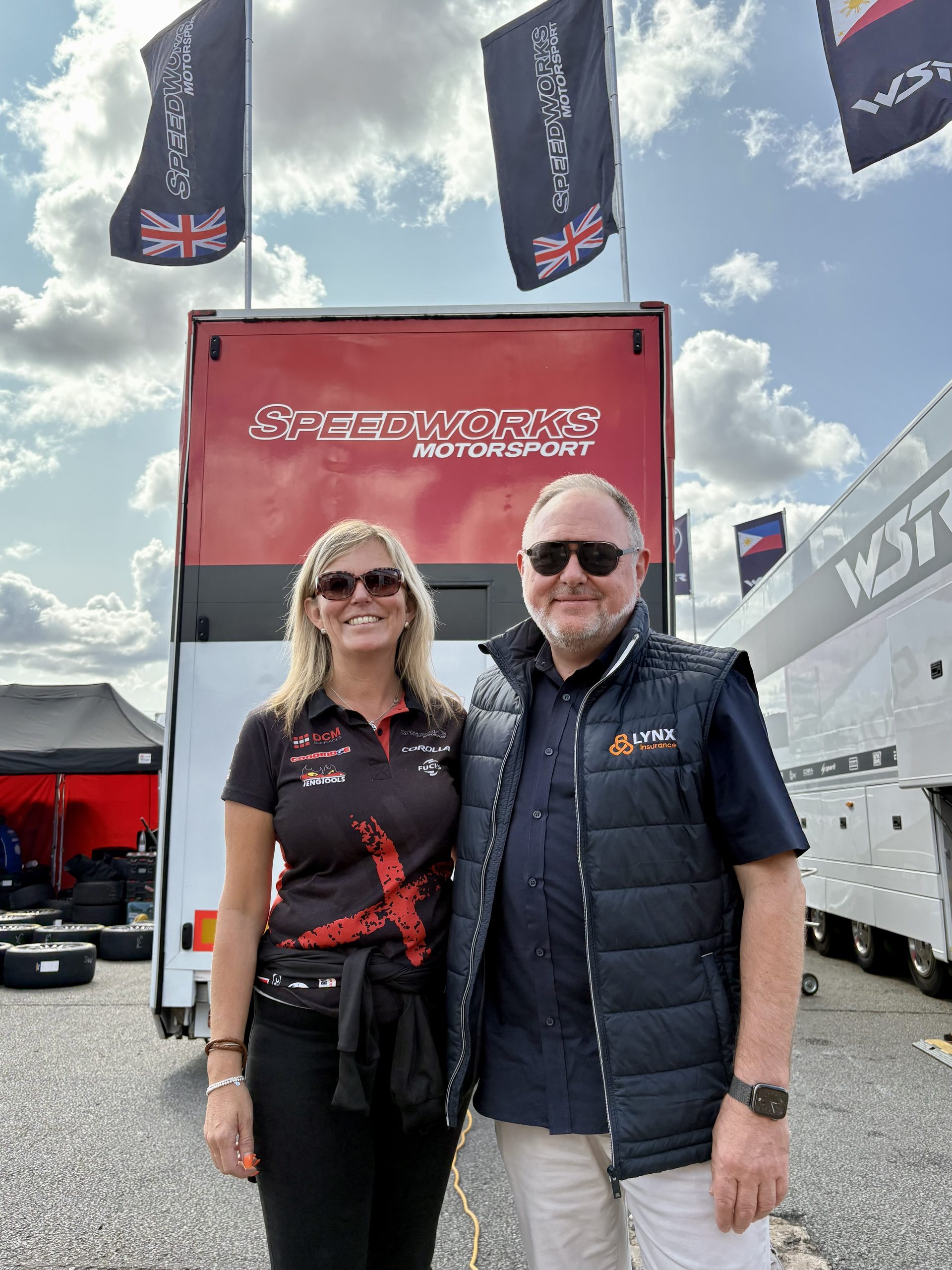
I caught up with Amy Dick at Donington recently.
I’ve looked after Amy and Christian’s insurance for more than ten years now. In that time, Speedworks Motorsport has grown from a relatively small operation into a much broader motorsport business, with BTCC, GT racing and driver development all forming part of what they do, including motorsport business insurance.
That sort of growth is good to see. It also creates one small problem. Businesses have a habit of changing rather faster than insurance paperwork.
A new race programme comes along. Another vehicle is bought. More equipment appears in the workshop. Somebody joins the team. A transporter gets changed. More time is spent testing, travelling or operating away from the main premises. None of these things feels especially dramatic when they happen one at a time. Then renewal comes around and you realise the business you insured three years ago bears only a passing resemblance to the one you are actually running.
Motorsport businesses rarely stand still
That is particularly true in motorsport. A normal commercial business might occupy the same building. It might sell the same thing and operate in roughly the same way for years. However, it can still face shifts in demand and partners. The pace of change varies by market.
Moreover, motorsport has other ideas. Cars change. Championships change. Staff change. Customers arrive with new requirements. Equipment gets more expensive. Vehicles are replaced. Work that was once done by somebody else suddenly comes in-house. And locations shift as operations grow. All of this shapes motorsport business insurance needs.
That is why I prefer to understand what somebody actually does rather than simply work through last year’s schedule and ask whether anything has changed. Because quite often, plenty has.
What should you be looking at?
Commercial combined insurance for a motorsport business can involve several different parts of the operation. There may be premises and contents. Tools and specialist equipment. Road vehicles. Road risks. Stock. Race cars or other assets being transported. Employers’ liability. Public liability.
Then there is the question of where everything is when the business is operating away from home. Moreover, a race team can have a remarkable amount of value sitting in a paddock on a Sunday morning. Additionally, unlike the office printer, most of it has wheels.
However, do not assume that something belonging to the business is automatically covered. It depends on what the policy actually says about coverage where you operate. You need to know what the policy actually says about motorsport business insurance.
On-track competition damage is another area where people need to be clear about the distinction. That normally requires separate consideration rather than simply sitting inside a standard commercial policy. These are the conversations worth having before the season gets properly underway.
However, Knowing motorsport helps with motorsport business insurance
There is a reason I enjoy working with motorsport businesses, including providers of motorsport business insurance. I understand the world they operate in. However, if someone says they added another race programme, I understand why. If they also bought another transporter or changed what they are doing at the circuit, I understand what that means.
That allows us to get onto the useful bit: whether the insurance still reflects what the business is actually doing. It sounds obvious. Unfortunately, insurance has a long and distinguished history of making obvious things unnecessarily complicated. At Lynx, we try not to.
Loyalty works both ways
One of the best parts of doing this job for a long time is that some clients stop feeling very much like clients. Amy and Christian are a good example. I have looked after them for more than a decade, watched the business change and grow, and somewhere along the way a professional relationship became a friendship too.
I am fortunate to have quite a few relationships like that across motorsport. And loyalty works both ways. If somebody has trusted you with their business for years, you do not take that for granted. You keep asking questions. You keep an eye on what has changed. And when something does change, you make sure you have the conversation.
Customer service should not disappear once the policy documents have been issued. With another season approaching, now is a sensible time to look at your own operation.
- Has the fleet changed?
- Have the assets changed?
- Have the assets changed?
- Have you bought more equipment?
- Are you travelling more?
- Has the team grown?
- Are you doing anything now that you were not doing at the last renewal?
If the answer to any of those is yes, it is probably worth a conversation. Preferably over a mug of Yorkshire Tea 😉